Brndle vs BuddyX vs Reign: Which Wbcom Theme Fits Which Client Brief
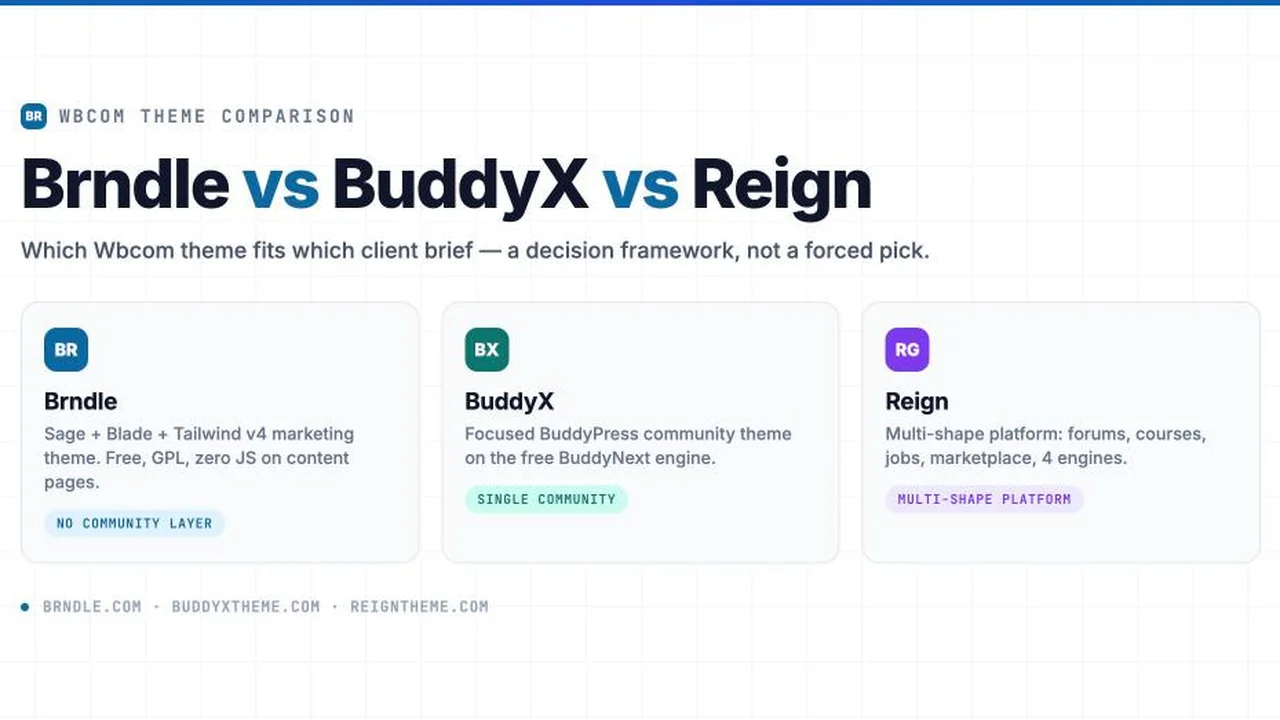
Wbcom Designs ships three WordPress theme products, and the sales pages make it easy to assume they are three competing answers to the same question, because they come from the same company and show up next to each other in search results. They are not. Brndle has never had a community feature in its codebase. BuddyX and Reign both ship as BuddyPress-native community themes, and if either of them competes with anything inside this company’s own lineup, it is with each other, not with Brndle.
This is the actual decision framework an agency or site owner needs: which of the three fits a given client brief, and, because BuddyX and Reign genuinely overlap, how to tell those two apart once a site needs community features at all. Nobody here is getting talked into a theme their site doesn’t need.
In this piece
- Why this isn’t a three-way shootout
- The decision framework: four questions
- Comparison table: all three, side by side
- Brndle, deep dive
- BuddyX, deep dive
- Reign, deep dive
- What actually separates BuddyX from Reign
- Three client briefs, three recommendations
- FAQ
- The bottom line
Why this isn’t a three-way shootout
A real shootout compares products doing the same job. Brndle doesn’t do the same job as the other two. It has no member profile template, no activity feed block, no groups directory, no BuddyPress or BuddyNext integration anywhere in its source. It is a marketing, business, and portfolio block theme built on Sage, Acorn, Laravel’s Blade templating, Tailwind CSS v4, and Vite 7, aimed at agencies and developers who want a theme that behaves like software rather than a page builder. If the brief is “landing pages, a pricing page, a blog, maybe a lead form,” Brndle is in the running. If the brief includes the words “member profiles,” “activity feed,” or “groups,” Brndle is not a candidate, full stop, and reading its spec sheet further is a waste of a billable hour.
BuddyX and Reign start from the opposite premise: the site needs people to sign up, have profiles, and interact with each other, and BuddyPress (or Wbcom’s own free BuddyNext engine) is doing the structural work underneath. Once a brief clears that bar, Brndle drops out of consideration entirely and the real decision becomes BuddyX versus Reign, which is a narrower and more interesting question than “which of the three Wbcom themes should I use,” because it’s the one where the two candidates’ feature lists actually overlap.
That’s the shape of this whole post: a hard fork at question one, then a genuine comparison on the branch where it’s warranted.
The decision framework: four questions
Four questions, asked in order, get almost any client brief to the right theme without guesswork.
1. Does this site need member accounts, profiles, activity feeds, or groups at all?
Not “might it someday.” Does the brief, as scoped and funded today, include people creating accounts and interacting with each other as a core feature, not an afterthought like a simple comment section or a gated PDF download? If no, skip to Brndle. If yes, BuddyX or Reign, and skip Brndle entirely; its theme layer has nothing to offer a community build and retrofitting BuddyPress onto a non-community theme is a worse starting point than picking a theme built around it.
2. Does the build team actually want a Blade/Tailwind developer stack, or does it want the standard WordPress block editor?
This only matters on the Brndle branch. Brndle’s blocks are registered by the theme and rendered through Blade views; editing a page template means editing Blade and Tailwind utility classes, which is exactly what a development-literate agency wants and exactly what a client-editable site without developer support does not want. A site owner who needs to tweak their own homepage without a developer on retainer should stay inside Brndle’s 20 native Gutenberg blocks and not touch the underlying templates; a dev shop that wants to extend the theme itself should expect to open resources/views/ and write Blade.
3. How many “shapes” of community does the site need beyond basic profiles?
A single forum is a different scope than forums plus courses plus a job board plus a marketplace plus events. Both BuddyX and Reign can run any of these through Wbcom’s companion community plugin stack (Jetonomy for forums, Learnomy or a third-party LMS for courses, MediaVerse for galleries), but Reign’s own positioning leans harder into supporting many simultaneous community “shapes” on one theme across a claimed 41 industries, while BuddyX’s marketing stays narrower: member profiles, activity feeds, groups, messaging, and a tighter LearnDash/Dokan integration path. A brief that’s genuinely just “a community with a feed and groups” doesn’t need the broader shape; a brief that’s “a members-only platform with courses, a directory, and a marketplace” is closer to what Reign is built to flex into.
4. What does the licensing actually cost at this site count, annual versus lifetime?
Both themes price by site count, and the gap between a 1-site license and a 20-site agency license is real money across a client portfolio. This is the question that turns “BuddyX or Reign” from a feature debate into a line item in a proposal, and it’s worth running the numbers before presenting either option to a client, not after.
Comparison table: all three, side by side
| Brndle | BuddyX | Reign | |
|---|---|---|---|
| Core job | Marketing / business / portfolio site, no community layer | Self-hosted community site, BuddyPress/BuddyNext-native | Multi-shape community platform: forums, courses, marketplace, jobs, events |
| Tech stack | Sage + Acorn + Blade + Tailwind CSS v4 + Vite 7 | Standard WordPress theme stack + BuddyNext engine | Standard WordPress theme stack + BuddyNext/BuddyPress/BuddyBoss/PeepSo compatibility |
| Community engine | None, by design | BuddyNext (free), also runs on BuddyPress and BuddyBoss | BuddyNext, BuddyPress, BuddyBoss, or PeepSo, pick the engine, Reign renders it |
| Native building blocks | 20 native Gutenberg blocks, zero JS on content pages, 12 color schemes, 8 font pairings, 8 header styles, 6 footers | Member profiles + activity feeds, private groups/spaces, messaging, forums via Jetonomy, galleries via MediaVerse, gamification | Member profiles, activity feeds, groups/spaces, courses, forums, events, job boards, directories, marketplace, messaging, media albums, 30+ demo imports |
| Pricing | $0, forever, no Pro tier exists | Free on WordPress.org; Pro: $79/yr (1 site), $119/yr (5 sites), $199/yr (unlimited sites), lifetime option listed | 1 site: $99/yr or $249 lifetime. 5 sites: $149/yr or $349 lifetime. 20 sites: $249/yr or $599 lifetime |
| License/activation | None, no key, no telemetry, no phone-home of any kind | Free tier has no license key; Pro requires one | Requires a license key for Pro features and updates |
| Best fit | Dev-literate agencies building fast marketing sites who want a real codebase, not a page builder | Single-community builds that want a clean, focused BuddyPress experience at the lowest entry price | Agencies or site owners who need several community “shapes” on one platform, or who manage many sites and want a flat per-tier price |
Pricing and feature details above are what’s published on each product’s own site as of this writing; confirm current figures before quoting a client, the same way you’d confirm any third-party vendor’s pricing before it goes in a proposal.
Brndle, deep dive
Brndle’s pitch is specific: a free, open-source, GPL-2.0-or-later WordPress theme for agencies and developers who are past the page-builder era and want a theme that reads like real software. It’s built on Sage and Acorn (Laravel’s application layer running inside WordPress), with Blade as the templating language and Tailwind CSS v4 compiled through Vite 7. Its 20 native blocks, hero, stats, features, comparison tables, pricing, testimonials, FAQs, CTAs, lead forms, and more, use block API version 3 with server-side rendering, which is the specific mechanism behind its zero-JavaScript-on-content-pages claim: there’s no client-side React hydration running these blocks, just Blade views rendering server-side HTML that consumes the same color presets and CSS variables as the rest of the theme.
Strengths worth naming plainly: there’s genuinely no Pro tier to upsell into, no license key to manage across client sites, and no telemetry phoning home. Twelve color schemes and eight font pairings give a dev team real design range without a page builder’s bloat, and the Lighthouse-100 claim is a direct consequence of shipping almost nothing extra to the browser. For an agency standardizing on a single theme for business and portfolio sites, that combination of GPL-2.0 licensing and zero activation friction removes two specific categories of long-term vendor risk: the theme can’t quietly turn into a paid bundle on renewal, because there’s no renewal, and a license server outage can never break a client site, because there’s no license server.
The honest limitation: Brndle is not a community theme and was never meant to become one. There’s no roadmap item that turns it into a BuddyPress wrapper, and bolting community plugins onto it would mean fighting the theme’s own template structure rather than working with it. If a brief needs member accounts of any kind, this is the wrong product regardless of how good its blocks are for everything else.
BuddyX, deep dive
BuddyX positions itself as the self-hosted alternative to Circle- and Skool-style SaaS community platforms, built around owning member data instead of renting it. The free version, currently at v5.1.9 on the WordPress.org theme directory, runs on BuddyNext, Wbcom’s own free community engine that handles the feed, spaces, members, and messaging layer, and the free theme also works with BuddyPress and BuddyBoss directly if a site is already running one of those. No license key and no upsell popups gate the free tier; it’s a complete, usable community theme at zero cost before anyone touches the Pro upgrade.
BuddyX Pro adds directory and header layout options, deeper LearnDash and Dokan integration for course- and marketplace-flavored communities, and priority email support, priced at $79/year for one site, $119/year for five, and $199/year for unlimited sites, with a lifetime option listed on the pricing page (the published tiers we pulled didn’t include a specific lifetime figure, so get the current number directly before it goes in a client quote). The feature set reads as deliberately focused: member profiles, activity feeds, private groups, built-in messaging, forums through Jetonomy, galleries through MediaVerse, and gamification through points and badges, rather than trying to be every kind of platform a community site could become.
That focus is the product’s actual strength for the right brief. A single-purpose community, a creator’s membership site, a niche hobby forum, a course community that needs LearnDash wired in cleanly, doesn’t need marketplace or job-board scaffolding sitting unused in the admin, and BuddyX’s narrower scope keeps the Pro price lower at every site tier than Reign’s equivalent tiers.
Reign, deep dive
Reign describes itself less as a single community type and more as a design system that renders whichever community shape a site owner picks. It explicitly supports more community engines than BuddyX does, BuddyNext, BuddyPress, BuddyBoss, and PeepSo, which matters specifically for an agency inheriting an existing site already built on PeepSo or BuddyBoss rather than starting from scratch. On top of profiles, activity feeds, and groups, Reign’s own feature list reaches into courses (via Learnomy or a third-party LMS), forums via Jetonomy, events, job boards, business directories, marketplace functionality, messaging, and media albums, with 30-plus demo sites available as a free importer to start from something closer to the finished brief than a blank install.
Pricing scales in the same three tiers as BuddyX but at a higher ceiling and with lifetime pricing published outright rather than left as an unlisted option: $99/year or $249 lifetime for one site, $149/year or $349 lifetime for five sites (marked as the most popular tier), and $249/year or $599 lifetime for up to twenty sites. All three tiers carry identical functionality; the only variable is how many production sites the license covers, and annual licenses renew at a stated 30% discount versus the first-year price.
The honest tradeoff: that breadth comes with more surface area. A site that only ever needs a feed and groups is paying for (and navigating admin screens built around) a theme designed to also handle marketplaces and job boards it will never use. Reign earns its price when a brief genuinely spans multiple community shapes or when an agency’s per-site economics favor the higher-tier lifetime pricing across a large client portfolio; it’s overbuilt for a brief that BuddyX’s narrower scope already covers at a lower price.
What actually separates BuddyX from Reign
Once a brief has cleared the “yes, this needs community features” bar, the real decision is this one, and it comes down to four honest differences rather than a single winner.
- Breadth of community engine support. BuddyX runs on BuddyNext, BuddyPress, or BuddyBoss. Reign adds PeepSo to that list. If a client is migrating an existing PeepSo site, Reign is the only one of the two that’s a direct fit; if the build is starting fresh or already committed to BuddyPress-family tooling, this difference doesn’t move the decision.
- Scope: focused community vs. multi-shape platform. BuddyX’s feature list stays inside member profiles, activity feeds, groups, messaging, forums, galleries, and gamification. Reign’s reaches further into courses, events, job boards, directories, and marketplace functionality as native-feeling parts of the same theme. A brief that’s purely social stays cheaper and simpler on BuddyX; a brief that’s “community plus marketplace plus job board” is closer to what Reign was built to flex into without stacking unrelated plugins on top of a narrower theme.
- Price at every tier. BuddyX undercuts Reign at every matching site count: $79 vs. $99 for one site, $119 vs. $149 for five, $199 vs. $249 for twenty, annually. That gap compounds across an agency’s whole client base, and it’s a legitimate reason to default to BuddyX whenever the narrower feature set is genuinely sufficient.
- Demo library and starting point. Reign’s 30-plus importable demos lean into “pick the closest match to your industry and customize,” useful for an agency pitching a client who wants to see something close to finished in the first call. BuddyX’s positioning stays closer to “build your own focused community,” which suits a team that wants a clean foundation rather than a demo to reverse-engineer.
Neither theme is the objectively better product. They’re priced and scoped for genuinely different briefs, and an agency that picks one as its permanent default for every community build is going to either overpay for Reign’s breadth on a simple project or hit a wall trying to stretch BuddyX’s narrower scope into a marketplace-and-jobs platform it wasn’t built for.
Three client briefs, three recommendations
Brief 1: A dev-shop client wants a fast marketing site and investor-facing landing pages for their SaaS product, no accounts, no login.
Recommendation: Brndle. No community features are in scope, the team already works in a modern dev stack and wants Blade and Tailwind rather than a page builder, and the zero-license-check model means the agency can standardize on it across every similar client without tracking activation keys.
Brief 2: A single creator wants a membership community around their course, with a feed, groups, and LearnDash-driven course access, launching on one site with a tight budget.
Recommendation: BuddyX. The brief is squarely inside BuddyX’s focused scope, profiles, feed, groups, LearnDash integration through Pro, and the $79/year single-site price beats Reign’s $99/year for functionality this brief doesn’t need anyway.
Brief 3: An agency is building a multi-vertical membership platform for a client that wants forums, a course area, a freelancer marketplace, and a job board, and the agency expects to roll the same foundation out to several more clients.
Recommendation: Reign. The brief spans exactly the community shapes Reign is built to flex into without plugin-stacking a narrower theme, and the 5-site or 20-site license tiers make sense once the agency is planning to reuse the foundation across a client roster rather than a single build.
FAQ
Can BuddyX and Reign run on the same site at the same time?
No, and there’s no reason to try. Both are full theme products built around the same free BuddyNext engine; picking one means the other isn’t active. The decision in this post is about which one to activate, not about combining them.
Can Brndle add community features later if a marketing site grows into a membership site?
Not without a theme change. Brndle’s architecture has no BuddyPress integration layer to extend, so a marketing site that genuinely outgrows into a membership platform is a theme migration to BuddyX or Reign, not a plugin install on top of Brndle. It’s worth flagging this possibility at the proposal stage if a client’s roadmap even hints at a future community phase.
Does Brndle support WooCommerce or any ecommerce features?
Brndle’s own feature set is marketing- and content-focused, blocks for pricing tables, testimonials, lead forms, and comparison tables, rather than shipping dedicated ecommerce templates. A client brief that needs a storefront, as opposed to a pricing page, needs that evaluated against Brndle’s actual WooCommerce compatibility separately from this comparison.
Is the free version of BuddyX actually usable, or is it a crippled trial of Pro?
It’s a complete community theme on its own: BuddyNext-powered profiles, feeds, groups, and messaging with no license key and no upsell popups blocking functionality. Pro adds directory/header layout options and deeper LearnDash/Dokan integration on top, not a missing core.
Why does Reign cost more than BuddyX at every tier if they share the same underlying BuddyNext engine?
The price difference tracks scope, not the shared engine. Reign’s theme layer supports more community shapes (courses, events, job boards, directories, marketplace) and more third-party engines (adding PeepSo to BuddyNext/BuddyPress/BuddyBoss), and that broader surface area is what the higher price is funding, not a different or more expensive version of BuddyNext itself.
Do any of these three themes require a paid license just to install and try?
No. Brndle has no paid tier at all. BuddyX and Reign both have free, fully functional base versions available before any Pro purchase, so a team can build and test a community site on either before committing to a license tier.
What happens to an existing BuddyX or Reign site if the agency later needs more licensed sites than the current tier covers?
Both products price by site count in discrete tiers (1/5/unlimited for BuddyX, 1/5/20 for Reign), so growing past a tier means upgrading the license, not losing access to sites already running under the current one. Check each vendor’s current upgrade path and pricing before committing a client portfolio to a specific tier.
Is Brndle a fair comparison to put next to two community themes at all, given it does something completely different?
That’s the point of leading with the decision framework rather than a feature-for-feature table: Brndle is here because it’s the third Wbcom theme product, not because it competes feature-for-feature with the other two. The honest answer for most briefs is that this comparison resolves in the first question, before BuddyX and Reign’s differences become relevant at all.
If a site needs both a marketing front door and a gated community area, which theme handles both?
Neither BuddyX nor Reign is weak at marketing pages, and both can serve as the single theme for a site that’s part public marketing, part gated community, since the community layer sits on top of a theme that still renders ordinary pages. Brndle isn’t built to absorb a community area bolted on afterward, so for a combined brief, start from BuddyX or Reign and build the marketing pages inside it, rather than starting from Brndle and trying to add community features later.
The bottom line
The question “Brndle, BuddyX, or Reign” is really two separate questions stacked on top of each other. The first is whether the site needs community features at all; if it doesn’t, Brndle is the only one of the three built for that job, and it’s free with no license to track. If it does, Brndle is out, and the real decision is between BuddyX‘s focused, lower-priced community scope and Reign‘s broader, multi-shape platform built for agencies spanning several community types or many sites. None of the three is a universal default, and that’s a feature of how Wbcom built them, not a gap in any one product. Pick based on what the brief actually asks for, not on which one happens to be the newest release.