Edufire LMS Theme Review 2026: Best WordPress Theme for E-Learning
Course platforms live or die on one metric more than any other: completion rate. A beautifully designed LMS site with a 15% completion rate is failing its students just as badly as an ugly one, and the theme sitting underneath the LMS plugin has more influence over that number than most course creators assume.
Why this gets decided badly so often
Most course creators pick an LMS theme the same way they’d pick a blog theme, browse a marketplace, filter by “education,” pick whatever looks polished in the demo screenshots. That process optimizes for first impressions, not for the thing that actually determines whether the course business succeeds, whether students who pay for a course actually finish it and get the result they were promised. A theme decision made on aesthetics alone routinely gets revisited six months later once the completion-rate data comes in and someone starts asking why so few students make it past module two.
What a theme actually controls in an LMS build
The LMS plugin, LearnDash, Tutor LMS, or LifterLMS, handles the mechanics: lesson sequencing, quiz logic, progress tracking, certificate generation. The theme controls everything the student sees and clicks through while doing that: how a course catalog is browsed, how a lesson page is laid out, whether a student can find where they left off without hunting through menus. Whether the whole experience feels like a coherent product or a WordPress site with a plugin bolted on.
That second part matters more than course creators often expect. A student who has to fight the interface to find their next lesson is a student who logs off and doesn’t come back, regardless of how good the actual course content is.
Edufire: what it does well
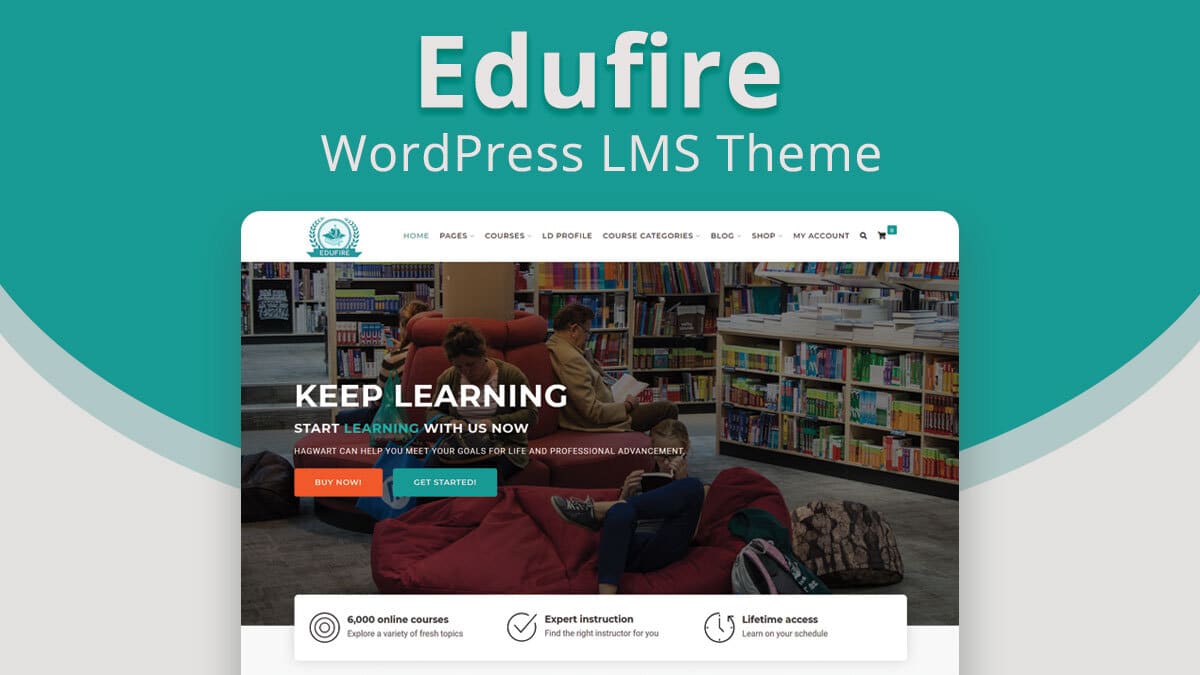
Edufire is built specifically around LearnDash, with course grid and list layouts, instructor profile pages, student dashboards, course search and filtering baked in rather than assembled from generic templates. For a straightforward LearnDash-powered course site, single instructor or a small handful, focused purely on content delivery, that specificity is genuinely useful: less configuration, fewer template conflicts, a design that was built with LearnDash’s data structure in mind from the start.
Where Edufire stays narrower is Tutor LMS support, which the theme handles at a basic level rather than the deep integration it offers LearnDash. It also doesn’t include built-in community or social features. For a course creator whose model is pure content delivery, watch a video, take a quiz, get a certificate, that’s not a gap. It’s scope discipline.
Where community features change the completion-rate math
This is the part worth taking seriously before dismissing it as a nice-to-have. Research on online learning consistently points to social interaction as a major factor in course completion, students who feel isolated in a self-paced course are far more likely to abandon it than students who have some sense of peers moving through the material alongside them.
That’s the argument for a theme like Reign, which pairs LearnDash, Tutor LMS, LifterLMS compatibility with BuddyPress’s community layer: student profiles, discussion groups tied to specific courses, cohort-style group learning, and instructor Q&A forums. The mechanism isn’t abstract, a student who’s part of a course discussion group has social accountability and peer momentum that a student working through the same material entirely alone doesn’t.
BuddyX Pro takes a related but distinct approach, closer to a social-learning platform than a course site with a community bolted on: study-buddy matching, course-specific activity feeds, private messaging between students. For younger or more digitally native audiences already comfortable with social-media-style interaction, that framing can lower the barrier to actually engaging with peers rather than just consuming content solo.
The honest trade-off
Community features aren’t free. They add setup complexity, ongoing moderation work, once students can post and message each other, someone needs to watch for spam and bad-faith behavior, and a learning curve for instructors who now need to engage with a discussion forum, not just record videos.
For a course with a handful of students and a single instructor who barely has time to make the videos, let alone moderate a forum, that overhead may cost more than the completion-rate benefit is worth. For a course business planning to scale past a few hundred students, or one where peer interaction is core to the actual learning outcome, coding bootcamps and cohort-based courses being clear examples, the community layer usually pays for itself in retention alone.
Practical criteria for choosing between a pure LMS theme and a community-integrated one
Course format matters most. Strictly self-paced, consume-and-move-on courses lean toward a focused theme like Edufire. Cohort-based courses, courses with live components, or anything positioned as a community as much as a curriculum lean toward Reign or BuddyX Pro.
Instructor bandwidth matters next. One person building and running everything solo should weigh the moderation and engagement burden of community features honestly before adding them, a half-built forum with no instructor participation is worse for completion rates than no forum at all.
Growth plans matter too. A course business planning to launch several courses and build a recognizable brand around the community, not just the content, benefits more from community infrastructure from day one than one bolted on after the fact once retention problems are already visible in the data.
What the three major LMS plugins actually differ on
Theme choice is downstream of LMS plugin choice, and it’s worth a closer look at what each plugin actually optimizes for before either decision gets made.
LearnDash has the longest track record and the deepest ecosystem of add-ons: advanced quizzing, course prerequisites, dynamic content dripping, integrations with most major page builders and membership plugins. It’s the plugin most themes, Edufire included, are built and tested against first, which shows up as fewer rendering surprises.
Tutor LMS has closed much of that gap in recent years, with a free tier that includes features LearnDash reserves for paid add-ons, a frontend course builder that doesn’t require touching wp-admin, and a cleaner default student dashboard. It’s a strong choice for course creators who want more out of the free tier before committing budget to a premium theme and plugin combination.
LifterLMS leans toward membership-style course delivery, tiered access, bundled memberships, course-plus-community packages sold as a single product. It’s the natural fit for course creators whose business model already resembles a membership site more than a single-course sale.
None of these differences are about which plugin is “best.” They’re about which pricing model, content structure, student experience matches the specific course business being built, and that decision should come before evaluating any theme’s LMS compatibility claims.
What the research on online course completion actually says
It’s worth being specific rather than gesturing vaguely at “engagement matters.” Multiple studies on MOOCs and online course platforms have found completion rates for fully self-paced, solo courses sitting in the single digits to low double digits, dramatically lower than cohort-based or instructor-led formats where students have some form of social accountability or a fixed schedule pulling them forward.
The mechanism isn’t mysterious. A student working through material entirely alone has no external pressure keeping them on track beyond their own motivation, and motivation alone is a famously unreliable engine for finishing anything that takes more than a few sessions. A discussion group, a cohort start date, a visible peer working through the same material, all introduce a form of social commitment that outperforms willpower on its own. This is the actual case for community features in an LMS build, not vague enthusiasm about “engagement,” but a specific, well-documented psychological mechanism that a theme’s community layer can support or fail to support.
Setting up an LMS site so students actually finish
A few decisions outside the theme itself move completion rates more than most course creators expect.
Course structure should default to short, clearly bounded lessons rather than long unbroken video blocks, a visible sense of progress, three lessons done out of twelve, is a stronger motivator than an undifferentiated hour of content. Automated reminder emails for students who’ve gone quiet catch a meaningful share of would-be dropouts before they’ve fully disengaged. And a clear, early first win, a quick early lesson that produces a visible result, sets the tone for whether a student treats the course as worth finishing.
None of this is theme-specific, but a well-chosen theme makes each of these easier to implement rather than fighting the interface to add them.
A checklist for evaluating any LMS theme before committing
Build a test course with at least five lessons and a quiz, then actually take it as a student would, not just glance at the admin side. Check whether progress tracking is visible and motivating rather than buried in a sidebar nobody looks at. Confirm certificate generation works and looks professional, since for many students that certificate is the tangible proof of completion they’ll actually share.
If community features are part of the plan, test them with at least two separate test accounts, not just the admin account. Post in a discussion group as each one. It’s the only way to catch whether the notification flow, the reply threading, the general usability of the discussion actually work the way a real student and a real instructor would expect.
Finally, check mobile specifically. A meaningful share of course consumption now happens on phones, squeezed into commutes and breaks. A video player or quiz interface that’s awkward on a small screen quietly costs completions that never show up as an obvious bug, students just quietly stop coming back on days they only have their phone available.
Frequently asked questions
Can I add BuddyPress community features to a theme like Edufire later?
Technically, BuddyPress can be installed alongside most themes, but a theme that wasn’t designed with BuddyPress in mind won’t render its templates correctly without custom development work. If community features are even a possibility down the line, it’s worth choosing a theme with tested BuddyPress compatibility from the start rather than retrofitting it later.
Does LearnDash work equally well with Tutor LMS-focused themes?
Not necessarily. A theme’s LMS integration is usually deepest with whichever plugin it was primarily built and tested against. Check a theme’s actual documentation for which LMS plugins receive full support versus basic compatibility before assuming any WordPress LMS theme works equally well with all three major plugins.
Is a community layer worth it for a course with fewer than 50 students?
It depends more on course format than student count. A tight-knit cohort of 20 students going through a bootcamp-style program together benefits enormously from community features. Twenty students taking a self-paced course independently, with no expectation of interacting, get less value from the same features. The moderation overhead may not be worth it at that scale.
What actually causes low completion rates if the theme isn’t the problem?
Course length and pacing are the most common culprits, courses that front-load too much content before any sense of progress or win. Unclear expectations about time commitment at signup is another, students who didn’t realize what they were committing to disengage faster than students who went in with accurate expectations. A theme can support good structure. It can’t fix a course that was poorly paced to begin with.
How do I know if my current LMS theme is hurting completion rates?
Check analytics for where students actually drop off, a specific lesson, a specific module, or evenly across the course. A sharp drop at one point usually points to content, pacing, or difficulty. A steady, gradual decline across the whole course is more often an engagement or interface problem, and that’s where a theme’s navigation, progress visibility, or community features (or lack of them) start to matter.
How much does switching LMS themes disrupt students mid-course?
Student progress and enrollment data live in the LMS plugin’s database, not the theme, so switching themes doesn’t erase anyone’s progress. What does change is the interface students have learned to navigate, and a mid-course theme switch is worth scheduling between cohorts or course launches rather than mid-stream, students adapting to a new layout while also trying to finish coursework is an unnecessary source of friction at exactly the wrong moment.
Do certificates and gamification features actually improve completion, or are they just decoration?
They work best as reinforcement for progress that’s already visible, not as a substitute for it. A certificate at the end matters more when students have had visible milestones along the way, badges for module completion, a progress bar that updates meaningfully, rather than one distant reward at the very end of a long course with no intermediate feedback.
Pricing considerations that outlast the theme decision
Course creators often compare theme prices in isolation, sixty dollars here versus fifty there, without pricing the full stack the theme sits inside. A dedicated LMS theme paired with a premium LMS plugin license, LearnDash’s premium add-ons or Tutor LMS Pro, plus a community layer if that’s part of the plan, adds up to a real annual cost before a single course sells. Price that whole stack against the expected revenue from the first cohort of students, not just the theme’s sticker price, before committing.
Renewal pricing deserves the same scrutiny. Some themes and plugins price aggressively for the first year and renew at a meaningfully higher rate, a detail easy to miss when comparing initial checkout prices across candidates. Check renewal terms specifically rather than assuming year one pricing holds indefinitely, and factor that ongoing cost into whatever per-student margin the course business actually needs to stay viable past its first cohort.
The actual decision
Edufire and similar focused LMS themes do one job well: a clean, dedicated course delivery experience without extra complexity. Reign and BuddyX Pro do a different job: course delivery plus the social infrastructure that measurably improves completion rates for the right kind of course. Neither is the universal right answer. The course format, the instructor’s actual bandwidth to run a community, and the growth plan behind the business should decide which one fits, not which theme has the longer feature list.
Take a test course as a student before making that call. The gap between how an LMS build looks on a features page and how it actually feels to sit through a lesson, take a quiz, and figure out where you left off tomorrow is where most of the real decision-relevant information lives.